
#Dental prosthetics
Dental Crowns Alba Iulia
Complete protection, natural appearance
At D'Alba Dentistry, our approach to restorative treatment is guided by the principles of biomimetic dentistry, whose main objective is to preserve as much natural tooth tissue as possible.
A dental crown is not the first treatment option, but a solution used only when the structure of the tooth is too badly affected to be restored by minimally invasive methods.
What to expect?

Digital scanning for maximum precision
Premium ceramic materials - e.max or zirconia
A temporary restoration while the final crown is being made
Natural integration in texture, colour and gum contour
#WHAT IT IS
What is a dental crown?

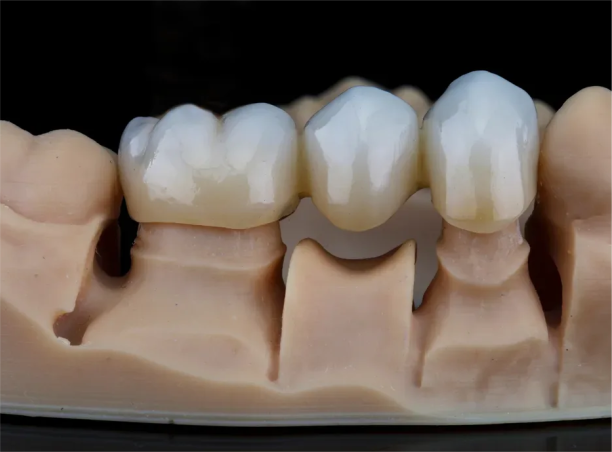
A dental crown is a prosthetic restoration that completely covers the tooth, protecting it and restoring its shape, function and appearance. Unlike a filling, which restores only part of the tooth, the crown envelops the entire visible surface, offering a level of protection and strength that no large filling can match in the long term.
The main indication for a dental crown arises when the tooth is structurally compromised and a conventional filling is no longer a durable solution. This can happen for several reasons - extensive decay, a fracture, previous root canal treatment or advanced wear - and the decision to opt for a crown is always taken following a full clinical assessment, not on the basis of a single criterion.
Something we frequently point out at D'Alba Dentistry is that a modern crown neither looks nor feels like „a thick false tooth”. Dental aesthetics have advanced considerably, and the ceramic materials available today make it possible to produce crowns whose translucency, texture and light reflection come close to those of a natural tooth. The result is a restoration that blends naturally into the arch, invisible to the untrained eye.
As well as its protective function, a dental crown also restores full chewing capacity, stabilises the bite and, in the case of front teeth, contributes significantly to the appearance of the smile. It is, in essence, a solution that addresses several issues at once - structure, function and aesthetics.

In which situations is a dental crown recommended?
When minimally invasive methods are no longer sufficient to restore a structurally compromised tooth, the dental crown becomes the reference solution. Here are the situations in which Dr Radu Podar most frequently recommends this option:
Large cavities with significant loss of tooth structure
When decay has destroyed a significant part of the tooth, a large filling becomes a solution with an increased long-term risk of fracture. The crown distributes chewing forces evenly across the whole surface of the tooth, removing this risk and offering superior protection.
Fractured or cracked teeth
A tooth fracture - whether caused by trauma, by bruxism or by untreated decay - can seriously compromise the integrity of the tooth. Depending on how deep the fracture is, a crown can save the tooth and prevent extraction by covering and stabilising the affected surface.
Root-treated (endodontically treated) teeth
After root canal treatment, the tooth loses a significant part of its structure and becomes more fragile and more prone to fracture. In most cases, protecting a root-treated tooth with a crown is not merely a recommendation - it is a necessity in order to ensure the longevity of the treatment and to help prevent root fracture.
Teeth with old, extensive fillings
Old fillings, particularly amalgam ones, can deteriorate over time, can create cracks in the dentine or can leave margins that allow bacteria to seep in. Replacing them with a modern ceramic crown offers a safer, more aesthetic and more durable solution.
Aesthetic restorations of the front teeth
When a front tooth requires a major change in shape or colour - for example, a severely discoloured or malformed tooth, or one previously rebuilt with materials that no longer give a satisfactory appearance - the ceramic crown is the solution that allows a complete and durable transformation of its appearance.
It is worth mentioning that in certain situations, especially for back teeth with moderate loss of tooth structure, a valuable alternative to a full crown is the inlay or onlay - a restoration made in the laboratory that partially or entirely covers the biting surface, preserving more of the tooth's natural structure. This option is assessed and discussed with the patient during the consultation, whenever the clinical situation allows.

#MATERIALS
Which materials do we use?
The quality of the material directly determines both the appearance and the durability of the dental crown. At D'Alba Dentistry in Alba Iulia, we select the appropriate material according to the position of the tooth, the chewing forces it is subjected to, the aesthetic objective and each patient's individual clinical situation.
Lithium disilicate (e.max) - for the front and side regions
E.max is today one of the most highly regarded ceramic materials available in dentistry. It offers an excellent balance between mechanical strength and aesthetics - it is strong enough to withstand normal chewing forces, yet translucent enough to reproduce the natural appearance of enamel. It is the material we recommend first for crowns in the front region and for premolars, where aesthetics and strength are equally essential. An e.max crown made correctly is practically impossible to tell apart from a natural tooth.
Zirconia - for the back region or cases with heavy chewing forces
Zirconia is currently the strongest ceramic material available for dental restorations. It is the ideal choice for molars - the teeth subjected to the greatest chewing forces - and for patients with bruxism or powerful chewing muscles. Modern generations of translucent zirconia have moved well beyond the „opaque white” reputation associated with classic zirconia, giving remarkable aesthetic results even in the visible region. For mixed cases, where both strength and maximum aesthetics are needed, zirconia layered with ceramic is a top-tier solution.
Layered ceramics - for advanced aesthetic cases
Ceramic layered by hand by an experienced technician represents the pinnacle of aesthetics in prosthetic restorations. By applying several layers of ceramic with different degrees of translucency and shade by hand, the technician can reproduce the optical characteristics of a natural tooth with remarkable fidelity. This option is reserved for advanced aesthetic cases, particularly in the front region, where every detail of colour, shadow and reflection matters.
The final choice of material is always made together with Dr Radu Podar, following a full assessment of the case and an open discussion about the patient's expectations and preferences.
How does dental crown treatment work at D'Alba Dentistry?
Dental crown treatment follows a clear, well-structured protocol that safeguards both the precision of the restoration and the patient's comfort throughout the process. At D'Alba Dentistry in Alba Iulia, every stage is explained to the patient before it is carried out - no surprises, no decisions taken without your agreement.
1. Consultation and full diagnosis
The first step is a detailed clinical assessment of the tooth and of the dental arch as a whole. The dentist examines the condition of the tooth, the vitality of the pulp, the state of the surrounding tissues and the occlusion, in order to establish whether a crown is the right solution and which type of material is recommended. If necessary, X-rays or a cone-beam tomography scan (CBCT) are taken for a complete picture.
2. Personalised treatment plan
On the basis of the diagnosis, the dentist draws up a clear treatment plan - the type of crown, the recommended material, the number of appointments needed and, where relevant, any preliminary treatment (for example, root canal treatment or a core build-up). The plan is presented and discussed with the patient before any treatment begins.
3. Tooth preparation and digital scan
Preparing the tooth involves the controlled reduction of its surface to create the space needed for the crown. Our aim is a preparation that is as conservative as possible, preserving as much healthy tooth structure as we can. Immediately after preparation, we take an intraoral digital scan that replaces the conventional impression - more precise, more comfortable and quicker. The scan data is sent directly to the dental technician for the crown to be made.
4. Temporary restoration
While the definitive crown is being made, the prepared tooth is protected with an aesthetic temporary crown, made in the clinic. This protects the prepared tooth, maintains the space and allows the patient to assess the shape and overall appearance of the final restoration before definitive cementation. You will not spend a single day with an unpresentable tooth.
5. Try-in and final cementation
Once the ceramic crown is complete, it is tried in the mouth before final cementation. We check the colour, shape, marginal fit, contact points and occlusion. If everything is as it should be - the patient is happy and the dentist confirms the technical precision - we proceed to final cementation with high-quality adhesive materials.
6. Check-up
A few weeks after cementation, we invite you back for a check-up to assess how the crown has integrated, your bite comfort and the health of the gum around the restoration. We also give you clear advice on hygiene and care, so that the restoration lasts as long as possible.
#WHY US
Why choose D'Alba Dentistry for a dental crown in Alba Iulia?

A dental crown made correctly can last 15, 20 years or more. One made without attention to detail - with an imprecise marginal fit, a poorly chosen material or an uncorrected bite - can cause problems within a few years. What makes the difference between these two scenarios is precisely the working philosophy of the clinic you choose.
At D'Alba Dentistry in Alba Iulia, every dental crown is made through a rigorous protocol supervised by Dr Radu Podar: full diagnosis, careful planning, precise digital scanning, premium ceramic materials and detailed checking before final cementation. No stage is rushed and there are no compromises on quality - because a prosthetic restoration is a long-term investment in your dental health and appearance.
Another aspect that sets us apart is transparent communication with the patient. Before any treatment, you will know exactly what will happen, with which material, in how many steps and with what expected result. You will wear a temporary restoration while the final crown is being made and you will approve its appearance before definitive cementation. No decision is taken without you.
We invest continually in modern technology - intraoral digital scanning, digital prosthetic planning and the latest generation of materials - because precision is not a detail but the foundation of any quality prosthetic work.
If you are in Alba Iulia or the surrounding area and need a dental crown or a full prosthetic assessment, we invite you to book a consultation at D'Alba Dentistry. The first step is simple - and a restoration carried out properly can make a real difference to your day-to-day comfort and confidence.
Protect your tooth with a quality ceramic crown. Book your consultation at D'Alba Dentistry - Alba Iulia.
services
Complete dental care for your smile

"A truly excellent experience at the dentist! The team is wonderfully attentive and the treatment was completely pain-free.”




Ready to transform your smile?
Don't put off caring for your smile. Book today and discover modern treatments, planned together with you, for a fresh, natural and lasting result.

Call us on
+40 743 868 112