
#3D digitally guided placement
Dental Implants Alba Iulia
The fixed, permanent solution for a missing tooth
The dental implant is the modern solution that comes closest to a natural tooth. At D'Alba Dentistry in Alba Iulia, every implant is planned digitally, placed with precision and integrated into a treatment plan designed for the long term - for a stable, aesthetic and durable result.
What to expect?

3D digital planning before the procedure
Placement with or without a surgical guide, depending on the case
A fixed solution - no removable dentures
A long-term aesthetic and functional result
#what it is
What is a dental implant and how does it work?

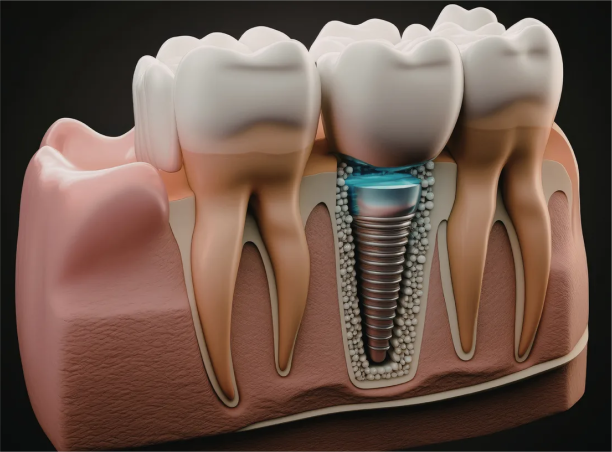
The dental implant is the modern solution for replacing a missing tooth, without preparing the neighbouring teeth and without resorting to a removable denture. Structurally, the implant acts as an artificial root - a post made of titanium or another biocompatible material - which is placed in the jawbone and on which a crown, a bridge or a complete fixed restoration is subsequently built.
Titanium is the standard material in implantology thanks to its remarkable properties: it is biocompatible, does not cause adverse reactions and is able to integrate directly into the bone structure through a process called osseointegration. In practical terms, within a few months the implant becomes part of the lower or upper jaw, just as the natural tooth root once was. The final result is a tooth that looks, feels and functions like a natural one: stable, comfortable, without movement and without any impact on the adjacent teeth.
Unlike a conventional dental bridge, an implant does not require the preparation of the healthy teeth beside the gap. Dr Radu Podar consistently emphasises that the implant is the most conservative and most predictable long-term solution for precisely this reason - it keeps the neighbouring teeth intact and addresses the real cause, not just the visible effect of a missing tooth.
One important point that we always emphasise to our patients at D'Alba Dentistry is that a dental implant is not only an aesthetic solution but a biological one. By stimulating the bone continuously, the implant prevents the bone resorption that occurs naturally when a tooth is missing. This means that, in the long term, the implant helps to maintain the structure of the face and of the dental arch as a whole.

Who are dental implants recommended for, and what problems do they solve?
Dental implants are recommended for a wide range of patients - from those who have lost a single tooth to those with extensive partial or complete tooth loss. Dr Radu Podar assesses each patient's eligibility during a full consultation, on the basis of a CBCT (cone-beam tomography) scan and a detailed clinical examination, in order to establish the most suitable treatment plan.
A single missing tooth
The most frequent situation: a tooth lost following trauma, an extraction or an infection. In this case the implant is the first-choice solution: it keeps the neighbouring teeth intact, restores the aesthetics and fully restores chewing function.
Several missing teeth
When several teeth are missing from an arch, implants can support a fixed bridge without requiring an implant for each individual tooth. The solution is more economical than individual implants and just as stable and functional.
Partial or complete tooth loss
Patients who have lost all or almost all of the teeth in an arch have the option of a complete fixed rehabilitation, through the All-on-4 or All-on-6 protocols.
Patients who do not want a removable denture
Many patients come to D'Alba Dentistry after years of wearing a removable denture, looking for a fixed, comfortable and stable alternative. An implant, or an implant-supported rehabilitation, offers exactly that: a solution that does not come out, does not move and does not cause discomfort when speaking or chewing.
Beyond the clinical indications, a dental implant solves, in very concrete terms, several problems that patients experience day to day. It restores chewing and comfort - you can eat what you enjoy, without restrictions or discomfort. It improves the appearance of your smile, as the implant crown is made from high-quality ceramic that closely mimics a natural tooth. It prevents neighbouring teeth from drifting, because an untreated gap leads over time to the movement of adjacent teeth and to changes in the bite. And, not least, it helps maintain bone volume: by stimulating the bone continuously, the implant prevents the progressive bone resorption typical of untreated gaps.

#solutions
What prosthetic solutions can be built on implants?
The dental implant itself is only the first part of the treatment - the foundation. On this foundation a variety of prosthetic solutions can be built, depending on the number of missing teeth, the clinical situation and the patient's preferences.
Implant crown - for a single missing tooth
This is the most common application of implantology. An individual ceramic crown is fixed onto the placed and osseointegrated implant, made to match the adjacent natural teeth precisely in shape, colour and size. The result is practically indistinguishable from a natural tooth, both aesthetically and functionally.
Implant-supported bridge - for several missing teeth
When two or more consecutive teeth are missing, implants can serve as abutments for a fixed bridge. An implant is not needed for every missing tooth - as a rule, two implants can support a three-unit bridge, which reduces both the cost and the extent of surgery. The solution is stable, aesthetic and durable.
Complete fixed rehabilitation
All-on-4 and All-on-6 are complete oral rehabilitation protocols intended for patients with complete or almost complete tooth loss who want a fixed, permanent solution. The principle is simple: four or six strategically placed implants support an entire fixed dental arch - a complete, stable restoration made from high-quality materials.
One of the major advantages of these protocols is that, in many cases, the patient goes home with a fixed temporary restoration on the very day of surgery - something that makes an enormous difference compared with the waiting period associated with conventional methods. The definitive restoration is made after osseointegration is complete, on the basis of digital scans and a precisely planned prosthetic design.
For both All-on-4 and All-on-6, three-dimensional digital planning and surgical guides are essential. They significantly increase the precision of implant placement, shorten the procedure and improve the predictability of the final result.
How does dental implant treatment work at D'Alba Dentistry?
The treatment protocol differs according to the type of rehabilitation chosen. Here is what the complete process looks like in each situation.
Dental implant for a single tooth — 6 steps:
1. Consultation + CBCT + digital planning
Everything begins with a full assessment: clinical examination, photographs and a cone-beam tomography scan (CBCT) that provides a precise three-dimensional picture of the available bone, of the nearby anatomical structures and of the optimum position for implant placement. On the basis of this data, the dentist carries out the digital planning of the case.
2. Implant placement, with or without a surgical guide
The implant is placed through a minor surgical procedure under local anaesthetic. Depending on the complexity of the case, we use digitally produced surgical guides, which ensure the implant is positioned exactly in line with the initial planning. This significantly reduces the risks and increases the predictability of the result.
3. Healing and osseointegration
After placement, the implant needs time to integrate fully into the bone, a process that takes on average between 3 and 6 months, depending on bone quality and the site of placement. During this period the area heals and the implant becomes stable and functional.
4. Scan for the implant crown
Once osseointegration is complete, we take a digital scan of the implant in order to design and order the final ceramic crown. The intraoral digital scan allows greater precision than conventional impressions.
5. Try-in + final restoration
The crown is tried in before final cementation, so that the colour, shape, marginal fit and occlusion can be checked. Only after full validation is the restoration completed.
6. Periodic check-up
A dental implant requires regular periodic check-ups, at least once a year, to check the integrity of the crown, the health of the gum around the implant and long-term stability.
Complete All-on-4 / All-on-6 rehabilitation — 6 steps:
1. Consultation + CBCT + scan + full plan
The assessment of complex cases is more elaborate and includes a detailed three-dimensional analysis of the entire arch, of the available bone volume and of the relationship between the upper and lower jaw. Planning is both surgical and prosthetic - the two components are considered together.
2. Digital surgical and prosthetic planning
Using specialised software, the dentist plans the exact position of each implant and designs the final prosthetic restoration before any surgery. The surgical guide is manufactured digitally on the basis of this planning.
3. Procedure with a surgical guide + fixed temporary restoration
On the day of the procedure, the implants are placed under guidance with maximum precision, and the patient receives a fixed temporary restoration - a stable complete arch that can be worn throughout osseointegration. This is one of the most appreciated features of the All-on-4/All-on-6 protocol: the patient does not leave without teeth.
4. Check-ups and healing
Throughout the osseointegration period (usually between 3 and 6 months) the patient is monitored regularly. The temporary restoration is adjusted if necessary, for optimum comfort and function.
5. Final restoration
Once successful osseointegration has been confirmed, the definitive prosthetic restoration is made from high-quality materials, digitally designed for a lasting aesthetic and functional result.
6. Periodic maintenance
Maintenance is essential for the longevity of the implants and of the final restoration. Periodic professional cleanings and regular check-ups support the health of the tissues around the implants and the long-term stability of the whole rehabilitation.
#why us
Why choose D'Alba Dentistry for a dental implant in Alba Iulia?

Implantology is one of the branches of dentistry that demands the highest level of training, equipment and clinical experience. An implant placed correctly, on the basis of rigorous planning, can last a lifetime. An implant placed without adequate planning can lead to complications that are costly and difficult to resolve. What makes the difference between these two scenarios is precisely the clinic and the dentist you choose.
At D'Alba Dentistry in Alba Iulia, every implantology case is approached by Dr Radu Podar with the same rigorous protocol: full assessment by CBCT, 3D digital planning, the use of surgical guides where the case requires it, and transparent communication with the patient at every stage. There are no surprises, no decisions taken without your agreement and no compromises on the materials or the technique used.
We work with implant systems of internationally proven clinical reputation and invest continually in technology and ongoing training, because in implantology development never stands still.
If you are in Alba Iulia or nearby and are looking for a fixed, stable and aesthetic solution for missing teeth, we invite you to book a consultation at D'Alba Dentistry. We assess your case fully, explain all the available options and propose a clear, personalised and realistic treatment plan.
The first step towards a complete and stable smile begins with a consultation. Book your appointment at D'Alba Dentistry - Alba Iulia.
services
Complete dental care for your smile

"A truly excellent experience at the dentist! The team is wonderfully attentive and the treatment was completely pain-free.”




Ready to transform your smile?
Don't put off caring for your smile. Book today and discover modern treatments, planned together with you, for a fresh, natural and lasting result.

Call us on
+40 743 868 112