
#Biomimetic Dentistry
Inlay / Onlay Alba Iulia
Precise restoration, natural tooth preserved
Inlays and onlays are among the most elegant solutions in modern dentistry - a middle path between a conventional filling and a full crown.
At D'Alba Dentistry in Alba Iulia, Dr Radu Podar recommends these restorations whenever the structure of the tooth allows it, because our philosophy is clear: preserve as much as possible, restore as precisely as possible.
What to expect?

Maximum preservation of the natural tooth structure
Greater precision than a conventional filling
Premium ceramic materials produced digitally or in the laboratory
A durable, stable and aesthetic long-term solution
#What it is
What are inlays and onlays, and how do they differ from a filling?

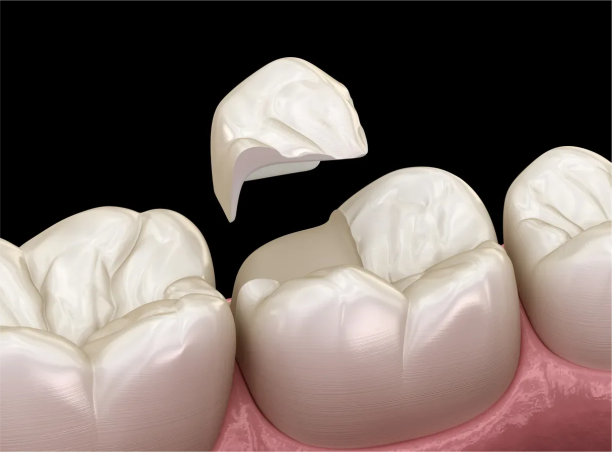
Inlays and onlays are indirect dental restorations - made outside the mouth, in a laboratory or using digital CAD/CAM technology, and then bonded to the tooth with high-precision adhesive materials. Unlike a conventional filling, which is shaped directly in the mouth by the dentist, inlays and onlays are manufactured with superior technical precision, fit perfectly onto the prepared surface and offer significantly greater mechanical strength over the long term.
The difference between an inlay and an onlay lies in the surface of the tooth that is covered. An inlay restores the area between the cusps of the tooth - essentially the inner part of the chewing surface - without covering their tips. An onlay, by contrast, also covers one or more cusps, providing additional protection when the tooth has lost a larger portion of its structure. There is also an extended version, known as an overlay, which covers the entire occlusal surface without being a full crown.
At D'Alba Dentistry, our approach to restorative treatment is guided by the principles of biomimetic dentistry, whose main objective is the maximum preservation of natural dental tissue. From this perspective, inlays and onlays represent an ideal solution because they provide a solid and durable restoration with a far more conservative preparation than a full crown, thereby preserving more of the tooth's original enamel and dentine.
Dr Radu Podar emphasises that inlays and onlays are not a compromise solution - quite the opposite: in the right cases they are the optimal solution, combining biological preservation of the tooth with a highly precise technical restoration. A tooth treated with a well-made ceramic inlay or onlay can be just as durable as one covered with a crown, with the advantage that far less of its natural structure has been affected.

When does Dr Radu Podar recommend an inlay or onlay instead of a filling or a crown?
The indication for an inlay or onlay arises in that specific clinical range where a conventional filling is no longer strong enough, but a full crown would mean a more aggressive preparation than necessary. This is the area in which biomimetic dentistry excels - minimally invasive treatment that delivers maximum results.
Large cavity with significant loss of tooth substance, but without compromise of the major cusps
When extensive decay has destroyed a significant portion of the tooth but the underlying structure remains intact, an inlay or onlay provides a solid restoration without the need to cover the tooth completely. A large filling would in this case be prone to fracture under masticatory forces, whereas an inlay or onlay addresses this fundamental problem.
Old, extensive or deteriorated restorations
Old amalgam or composite fillings deteriorate over time: they can crack, break down at the margins or allow bacterial leakage. Replacing them with a modern ceramic inlay or onlay provides a solution with superior marginal adaptation, greater strength and significantly improved aesthetics, without resorting to a crown.
Preventing fractures in teeth with thinned walls
A tooth with a large cavity and thinned dentine walls is prone to vertical fractures - one of the most serious complications in dentistry, which can lead to the loss of the tooth. An onlay covers and protects these vulnerable cusps, distributing masticatory forces evenly and significantly reducing the risk of fracture.
Root-treated teeth with moderate loss of substance
After root canal treatment, a tooth becomes more fragile and needs additional protection. In cases where the loss of substance is moderate, an onlay can be a more conservative alternative to a full crown, protecting the tooth effectively without excessive preparation.
The wish to preserve as much of the natural tooth as possible
There are patients who, once properly informed about the available options, consciously choose the most biologically conservative solution. For them, an inlay or onlay is the direct answer - a solid restoration achieved with minimal sacrifice of healthy tooth tissue.
It is worth noting that inlays and onlays are solutions intended mainly for molars and premolars - the posterior teeth, which are subject to the greatest masticatory forces. They are not indicated in every clinical situation, and the final decision always rests with Dr Radu Podar, following a detailed assessment of each individual case.

#materials
Which materials do we use for inlays and onlays at D'Alba Dentistry?
The quality of the final restoration depends directly on the quality of the material it is made from and on the precision with which it is manufactured. At D'Alba Dentistry in Alba Iulia, we work with materials selected according to the position of the tooth, the masticatory forces it is subjected to and the aesthetic objective of each patient.
Lithium disilicate ceramic (e.max) - the benchmark premium option
Lithium disilicate, known commercially as e.max, is today the material of choice for ceramic inlays and onlays. The reason is simple: it offers an exceptional balance between the mechanical strength required in the posterior region, where masticatory forces are high, and the natural aesthetics essential for an invisible result. The translucency of e.max faithfully reproduces the appearance of natural enamel, and its fracture resistance is superior to that of classic feldspathic ceramics. It is the material Dr Radu Podar recommends in the great majority of inlay and onlay cases at D'Alba Dentistry.
An e.max inlay or onlay that is well made and correctly bonded can integrate so well with the tooth that it becomes virtually impossible to identify on visual inspection - in shape as well as in shade and translucency. Over the long term, it withstands normal masticatory forces without significant deterioration and does not discolour over time in the way direct composite resins do.
Laboratory composite - a selective option for certain cases
Laboratory composite is an alternative to ceramic, used selectively in specific situations - for example, in cases where occlusal forces are lower, where there are financial considerations, or where the dentist judges that a less rigid material is more appropriate for that particular tooth. Compared with a directly placed composite, laboratory composite offers better marginal adaptation and greater density, because it is polymerised under controlled conditions rather than inside the mouth.
The choice between ceramic and laboratory composite is always made following a full assessment of the case, taking into account all the relevant clinical factors as well as the patient's preferences. There is no universal solution; there is the right solution for each individual tooth and each individual patient.
How does inlay or onlay treatment work at D'Alba Dentistry?
Inlay and onlay treatment follows a structured six-step protocol, similar to that for dental crowns but with a more conservative preparation. At our clinic in Alba Iulia, every stage is explained to the patient before it is carried out, because transparency is part of the way we work.
1. Consultation and full diagnosis
The first appointment is dedicated to a detailed clinical assessment of the tooth and of the arch as a whole. Dr Radu Podar assesses the extent of the decay or of the existing restoration, the condition of the dentine walls, the vitality of the pulp and the occlusion, in order to determine whether an inlay or onlay is the right solution or whether the clinical situation calls for a different approach. If necessary, radiographs are taken to give a complete picture of the tooth structure and the supporting tissues.
2. Personalised treatment plan
Based on the diagnosis, we determine the type of restoration - inlay or onlay - the recommended material and the number of appointments required. If any preliminary treatment is needed, for example root canal treatment or a core build-up, this is planned and explained to the patient before the preparation begins.
3. Preparation and digital scan
Preparing a tooth for an inlay or onlay is, by definition, more conservative than preparing it for a crown. The dentist removes the decayed tissue or the old restoration and prepares a cavity with parallel walls and clear angles, allowing the restoration to fit precisely. Immediately after preparation, we take a digital intraoral scan, which is more accurate, more comfortable and quicker than a conventional silicone impression. The data are then sent digitally for the inlay or onlay to be manufactured.
4. Temporary restoration (when required)
While the definitive restoration is being made, the prepared tooth is protected with a temporary restoration that maintains the shape of the cavity, protects the exposed dentine and keeps the patient comfortable when chewing. A temporary restoration is not required in every case - the decision rests with the dentist, depending on the clinical situation.
5. Try-in and final cementation
The inlay or onlay is tried in the mouth before final cementation. We check the marginal adaptation, the proximal contacts, the occlusion and the aesthetic appearance. If everything is correct and the patient confirms they are comfortable, we proceed to definitive adhesive cementation - an essential technical step, because correct bonding largely determines the longevity of the restoration and how well it integrates with the remaining tooth structure.
6. Check-up
A few weeks after cementation, the patient is invited back for a check-up to verify how well the restoration has integrated, the occlusal comfort and the health of the gum around the treated tooth. Personalised hygiene advice is also provided, to help the inlay or onlay last as long as possible.
#why us
Why choose D'Alba Dentistry for inlays and onlays in Alba Iulia?

Inlays and onlays are restorations that demand a high degree of technical precision, both from the dentist and from the dental technician. An indirect restoration made with imprecise marginal adaptation or cemented incorrectly can fail far more quickly than one carried out properly, and can lead to complications that are harder to resolve. The difference is made by clinical philosophy and attention to detail.
At D'Alba Dentistry in Alba Iulia, inlays and onlays are made following a rigorous protocol supervised by Dr Radu Podar and based on the principles of biomimetic dentistry - maximum preservation of natural tooth tissue, digital precision and high-quality ceramic materials. We use the latest generation of intraoral scanning systems, which eliminate the errors typical of conventional impressions and allow restorations to be manufactured with exceptional marginal adaptation.
One aspect we consider essential is transparent communication with the patient. Before any procedure, you will know exactly what type of restoration is planned, with which material, in how many steps and why this solution is right for your specific case. There are no treatments recommended „as a matter of routine" at D'Alba Dentistry - every clinical decision is justified and explained.
We choose an inlay or onlay when it is the correct solution from a biological and clinical point of view - not because it is quicker or simpler, but because, in the right cases, it is the best thing we can do for your tooth in the long term. This is the essence of the biomimetic dentistry Dr Radu Podar practises at D'Alba Dentistry.
If you are from Alba Iulia or the surrounding area and need an assessment for a dental restoration - whether for a large cavity, an old filling or a weakened tooth - we invite you to book a consultation. We will review the clinical situation and propose the most conservative and durable solution for your case.
services
Complete dental care for your smile

"A truly excellent experience at the dentist! The team is wonderfully attentive and the treatment was completely pain-free.”




Ready to transform your smile?
Don't put off caring for your smile. Book today and discover modern treatments, planned together with you, for a fresh, natural and lasting result.

Call us on
+40 743 868 112