
#Lead dentist
Dr. Radu Podar, dentist in Alba Iulia, Romania

Dr. Radu Podar is a dentist based in Alba Iulia, Romania, founder and lead clinician of D'Alba Dentistry, on Calea Moților 107. His clinical work centres on aesthetic dentistry, implantology, digitally guided implant surgery and prosthetic reconstruction on implants, with a consistent emphasis on minimally invasive treatment and digital workflows.
His professional path combines early clinical exposure to oral surgery, a training period in Germany devoted to restorative and digital dentistry, and an ongoing programme of hands-on courses in implantology, periodontology, endodontics and aesthetic dentistry. This page sets out that training in detail, for patients who want to know who will be treating them before they book.
Who is Dr. Radu Podar
Dr. Radu Podar practises as a dentist in Alba Iulia, at the D'Alba Dentistry practice on Calea Moților 107, where he is founder and lead clinician. His work is concentrated on aesthetic dentistry and ceramic veneers, implantology, digitally guided implant surgery and prosthetic reconstruction on implants.
Alongside these, he covers biomimetic and minimally invasive dentistry, indirect adhesive restorations, periodontology and soft tissue management, endodontics and prosthodontics. The practice is equipped along the same logic: intraoral scanning, CAD/CAM design, 3D printing, digital radiology and photographic documentation of every case, so that the stages of a treatment can be planned and checked before they are carried out.
D'Alba Dentistry works as a practice where digital planning is part of the protocol, and the shape of the future smile is chosen digitally together with the patient, not imposed by the dentist or the technician. The clinic has a partnership with Studio Dentics, in Germany, where Dr. Radu Podar completed his training in restorative dentistry.
Training in oral surgery and implantology, alongside Prof. Dr. Simion Bran
The interest in oral surgery and implantology appeared while he was still at university. For two years, in parallel with his studies, Dr. Radu Podar took part regularly in the clinical work carried out at Prof. Dr. Simion Bran's practice.
During that period he assisted closely on oral surgery and implantology procedures, taking part as surgical assistant. The exposure covered the full chain of a surgical case:

case planning and assessment of the initial situation;
the surgical stages themselves, followed from the operating table;
working protocols and instrument discipline;
managing the patient before, during and after the procedure.
Two years of surgical assistance during university is early clinical exposure, hard to obtain through ordinary academic courses. A student who enters the operating room sees things that do not appear in textbooks: how bone behaves under the bur, how the gum behaves under suture, how much the planning done before the first incision matters, and what happens when the real anatomy differs from the expected one.
This stage built the foundation for the later interest in implantology, guided surgery and prosthetic reconstruction on implants, three directions that are present today in the work at the practice. They are not three separate specialities, but three stages of the same route: you plan prosthetically, you operate guided, you restore adhesively.
International training: restorative and digital dentistry in Germany

Dr. Radu Podar later spent roughly three months in Germany, at Studio Dentics, where he went deeper into current protocols in restorative and digital dentistry. Studio Dentics is today a partner of the Alba Iulia clinic, and the protocols learned there are present in the way the practice works.
The experience included hands-on work across several areas:
modern adhesion protocols, essential for restorations that preserve tooth structure;
aesthetic restorations and the planning of aesthetic dentistry cases;
diagnosis and standardised photographic documentation;
intraoral scanning and digital workflows;
CAD/CAM design;
3D printing;
integrating digital technology into restorative treatment.
This stage explains the present orientation towards minimally invasive, adhesive and digital dentistry. Adhesion done correctly allows restorations that bond to the tooth instead of covering it after extensive preparation, while the digital workflow allows the final shape to be designed and checked before anything is done to the tooth.
Standardised photographic documentation, learned in the same period, has a practical role for the patient: the initial photographs become the reference against which the result is measured, and the material from which the laboratory understands which colour, texture and shape have to be reproduced. Without that documentation, the exchange between practice and technician stays approximate.
Continuing education: programmes completed and planned for 2026

Aesthetic dentistry and implantology change quickly, and the difference between a protocol from ten years ago and a current one is visible in the result. Dr. Radu Podar takes part regularly in courses and training programmes, devoted in particular to aesthetic dentistry, implantology, oral surgery, bone regeneration, periodontology, adhesive restorations and digital workflows.
Recent programmes and those planned for 2026 include:
Implantology, surgery and bone regeneration
Hands-on Socket Grafting, lateral augmentation and graft stabilisation, including an Augma Lift demonstration. The course covers the techniques for preserving and rebuilding bone after extraction, a stage that decides whether an implant can be positioned correctly for the prosthetic work.
Implant Summit 2026, a programme devoted to contemporary implantology and the management of complex cases.
Hands-on Soft Tissue Management, led by Dr. Roman Doli, focused on managing the soft tissue around implants and restorations.
Periodontology
Treatment of periodontal disease and mucogingival surgery, a full programme in six modules, led by Dr. Flavius Popa. Periodontal health is the basic condition for any prosthetic or aesthetic work meant to last.
Aesthetic dentistry and digital workflow
Sequence 2.0, Dental Masters Academy, an intensive three-day programme focused on aesthetic dentistry and the complete digital workflow, from photo and video documentation and planning in SmileCloud through to the laboratory, try-in and cementation of the restorations. Led by Dr. Adrian Argint, Dr. Lenu Boca and Dr. Ciprian Boca.
Recording and correcting the intermaxillary relationship digitally, a course devoted to integrating occlusion into the digital workflow. Occlusion recorded correctly is what makes an aesthetic restoration hold up over time under function, not only in a photograph.
Endodontics
Courses in modern endodontics, with an emphasis on predictable preparation, disinfection and obturation of the root canal system.
To these are added attendance at congresses and other continuing medical education programmes in dentistry.
Clinical areas covered at D'Alba Dentistry
Current clinical work covers both routine treatment and the cases that require complex planning. The main directions are:
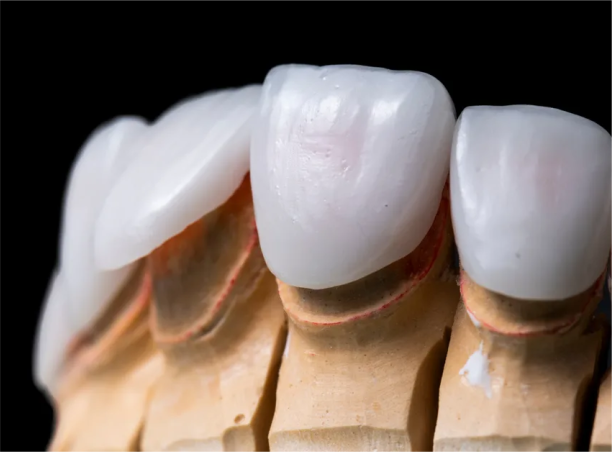
Ceramic veneers, indirect adhesive restorations of the onlay and overlay type, partial restorations, deep margin management and the restoration of severely compromised teeth. This is where the biomimetic principle applies most directly: as much healthy tooth structure as possible is preserved.
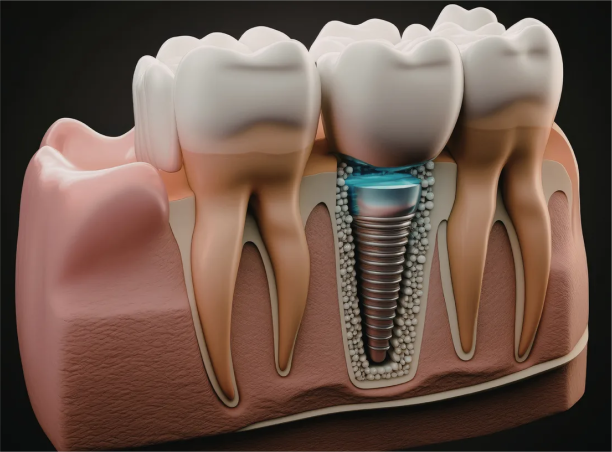
Three-dimensional diagnosis and planning, digitally guided implant surgery, prosthetically guided implant positioning, prosthetic reconstruction on implants, bone regeneration procedures and soft tissue management.
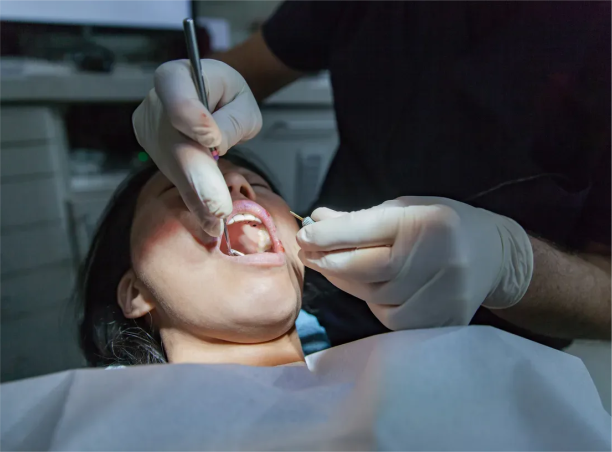
Periodontology
Treatment of periodontal disease and mucogingival surgery, as the foundation for the long-term stability of prosthetic work.
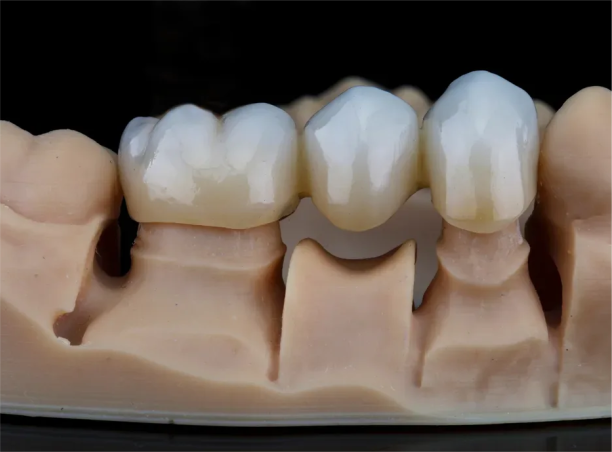
Root canal treatment carried out to current protocols, dental crowns, inlays and onlays, prosthetic rehabilitation.
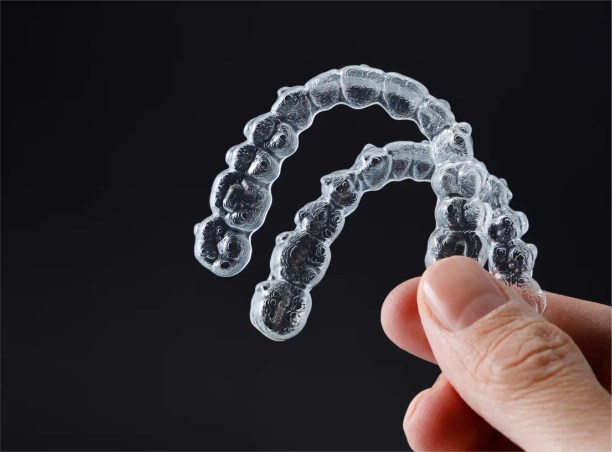
Spark aligners for orthodontic correction, plus prevention programmes and maintenance of the result. Aligning the teeth before aesthetic work reduces, in many situations, the amount of tissue that would have to be removed to reach the same final shape.
A complex case often passes through several of these areas. A rehabilitation on implants begins with periodontal assessment, continues with three-dimensional planning and surgery, then the prosthetic stage and, at the end, a maintenance programme. The fact that these stages are coordinated by the same clinician shortens the patient's route and keeps the initial plan coherent.
Clinical philosophy: minimally invasive, adhesive and digitally guided
The clinical approach aims to preserve as much healthy tooth structure as possible and to integrate digital technology where it increases the precision and predictability of treatment.
In restorative and aesthetic cases, an adhesive and minimally invasive solution is preferred whenever the clinical situation allows it, rather than extensive preparation of dental tissue. A tooth prepared conservatively remains a tooth with biological reserve for the future, and that matters most in younger patients.
In implantology, the emphasis falls on diagnosis, three-dimensional planning and positioning the implant according to the final prosthetic shape, not the other way round. The implant is placed where the tooth will sit, and the digital workflow connects planning to execution.
In aesthetics, digital planning lets the patient see and approve the aesthetic direction before any intervention. At D'Alba Dentistry, the shape of the future smile is chosen digitally together with the patient, adapted to individual features and preferences, not imposed by the dentist or the technician. Results can vary depending on the clinical situation, oral hygiene and adherence to post-treatment advice, and these variables are discussed openly at the consultation.
How a first consultation works
The first visit is, in essence, a stage of diagnosis and discussion, not of treatment. The usual structure of an initial consultation at D'Alba Dentistry looks like this:
The initial discussion
What is bothering you, what you have tried so far, what you expect from treatment and what general medical history there is. Many decisions about the plan change depending on the answers here.
The clinical examination
Assessment of the teeth, the gums and the way the arches close. Occlusion is checked because it determines how long a restoration lasts.
Imaging investigations
Digital radiology and, in complex surgical or prosthetic cases, a three-dimensional assessment showing the available bone volume.
Documenting the case
Photographs and, where relevant, intraoral scanning, which replaces the classic impression with impression materials.
Presenting the options
The possible options, with the stages, estimated duration and implications of each, including the option of not intervening straight away.
The decision does not have to be made in the same appointment. A complex treatment plan deserves time to think, and a second conversation after you have read the proposal is entirely normal.
Why a dentist's experience matters
When you are looking for a dentist for complex treatment, such as implants or veneers, the clinician's training is a criterion every bit as important as the equipment. A few useful markers when comparing your options:
Documented continuing education. Recent hands-on courses show that the protocols in use are current.
Surgical exposure. Time spent as a surgical assistant in oral surgery builds an understanding of the anatomy and of the limits of an intervention.
A complete digital workflow. Intraoral scanning, CAD/CAM design and 3D printing reduce the number of approximations between planning and result.
A coherent team. A practice where planning, surgery and the prosthetic stage follow the same protocol delivers a more predictable result than one where the stages are treated separately.
Frequently asked questions about Dr. Radu Podar
Who is Dr. Radu Podar?
Dr. Radu Podar is a dentist in Alba Iulia, Romania, founder and lead clinician of D'Alba Dentistry, on Calea Moților 107. His clinical work is oriented towards aesthetic dentistry, implantology, digitally guided implant surgery, prosthetic reconstruction on implants and minimally invasive dentistry.
What treatments does Dr. Radu Podar carry out?
The main areas are aesthetic dentistry and ceramic veneers, implantology and digitally guided surgery, prosthetic reconstruction on implants, indirect adhesive restorations of the onlay and overlay type, periodontology and soft tissue management, endodontics and prosthodontics. The practice also covers orthodontics with Spark aligners and prevention programmes.
Where did Dr. Radu Podar train?
His early clinical training took place over two years at Prof. Dr. Simion Bran's practice, as a surgical assistant in oral surgery and implantology. This was followed by roughly three months at Studio Dentics, in Germany, devoted to restorative and digital dentistry, plus an ongoing programme of professional development courses.
What does minimally invasive dentistry mean?
It is the approach in which only the affected dental tissue is removed, preserving as much of the healthy tooth structure as possible. It relies on adhesive techniques and partial restorations, such as onlays and thin veneers, rather than extensive reduction for crowns. Whether it is indicated is decided at the consultation, tooth by tooth.
What does digitally guided implant surgery involve?
The position of the implant is planned in advance on a three-dimensional reconstruction of the jaw, correlated with the intended prosthetic shape. That planning produces a surgical guide which transfers the calculated position into the mouth. The aim is for the implant to support the future prosthetic work correctly.
What does a complete digital workflow bring the patient?
Intraoral scanning replaces the classic impression, while CAD/CAM design and 3D printing allow the shape of the restoration to be checked before it is finally made. In practice, this reduces the number of stages where the result depends on an approximation, and the patient can see the proposed aesthetic direction before the tooth is touched.
Does Dr. Radu Podar treat complex cases as well?
Yes — his areas of interest include prosthetic reconstruction on implants, restoring severely compromised teeth and deep margin management, meaning the situations where the lesion extends below the gum line. Feasibility is established case by case, after clinical and imaging assessment, and sometimes the plan is carried out in stages.
How do I book a consultation with Dr. Radu Podar?
Appointments are made by phone, on the practice number, or through the form on the site. At the first visit there is a clinical assessment, the necessary investigations and a discussion of the treatment options, together with the stages and estimated duration of each.

Book at D'Alba Dentistry, a dental practice in Alba Iulia, Romania
If you are considering aesthetic dental treatment, a dental implant or a prosthetic rehabilitation, the first step is an assessment at the practice. There the clinical situation, the possible options and the stages of each are discussed, without the decision having to be made in the same visit.

Call us on
+40 743 868 112Calea Moților 107, Alba Iulia